Evaluation metrics
Apart from qualitative visual comparison, it is important to have a refined evaluation metric for class activation maps. This submodule is dedicated to the evaluation of CAM methods.
Run the performance benchmark notebook (Colab) to evaluate confidence scores and deletion/insertion AUCs, compare explicit baselines, and record runtime metadata.
Both metrics compute CAMs from the model's raw output. A logits_fn such as softmax changes only the scores used to measure the explanation. It does not change the score differentiated by a gradient-based CAM. Class indices and callable targets select the same outputs before and after this score transform, so logits_fn must preserve that output layout.
The score transform receives separate tensor copies with no autograd graph. This also applies to tensor leaves in dictionaries, lists, and tuples, including named tuples. Thus, an in-place score transform does not change the raw outputs used to build the CAM. Use output_fn to convert custom output objects into these supported containers before score transformation.
Use output_fn when the model output needs an adapter. The adapter runs before both CAM extraction and metric scoring, including extra model calls inside methods such as ScoreCAM and SmoothGradCAMpp. It does not change the model output outside the metric update. For example, a model that returns a dictionary of batched logits can use:
from functools import partial
from operator import itemgetter

import torch

from torchcam.metrics import ClassificationMetric

metric = ClassificationMetric(
    cam_extractor,
    logits_fn=partial(torch.softmax, dim=-1),
    output_fn=itemgetter("logits"),
)
metric.update(input_tensor)
If you previously used logits_fn to extract or reshape a model output, move that adapter to output_fn. Keep the probability transform in logits_fn. Native per-sample list outputs still work with callable targets and do not require an adapter. The target must accept the same per-sample structure from both the raw and transformed outputs.
Preserve the class identity and order expected by the CAM extractor when adapting outputs. For example, CAM selects classifier weight rows directly. Extracting output["logits"] preserves those class indices; an arbitrary class permutation is not supported across all CAM methods.
Classification confidence
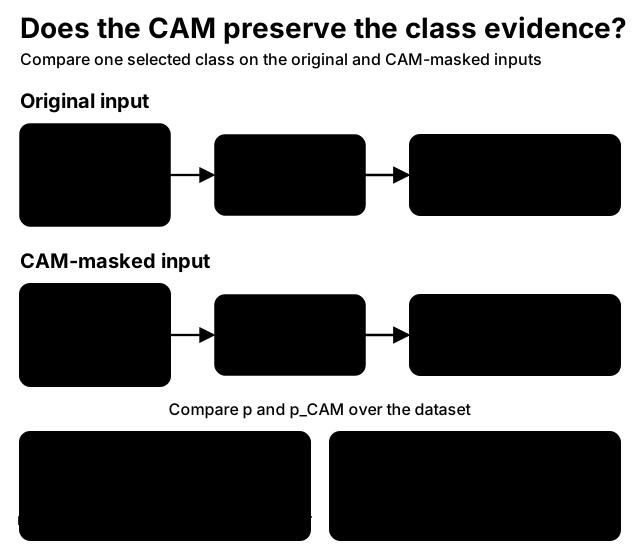
Average Drop uses the exact relative loss for each positive original confidence. It does not add an epsilon to the denominator, which would suppress drops at small confidence values. When the original confidence is zero, its drop is defined as zero. A larger masked confidence still counts as an increase.
Selected original and masked scores must be finite and nonnegative. Positive raw scores remain supported, but use probabilities to compare with published confidence metrics. Negative scores raise ValueError; Average Drop has no confidence-loss interpretation for a negative denominator. Use deletion/insertion for signed scalar targets.
Both metrics reject nonfinite selected scores with ValueError and leave their accumulated results unchanged. CAMs that contain NaNs are still skipped and counted by nan_count.
ClassificationMetric(cam_extractor: _CAMExtractor, logits_fn: Callable[[Any], Any] | None = None, *, output_fn: Callable[[Any], Any] | None = None)
Implements Average Drop and Increase in Confidence from "Grad-CAM++: Improved Visual Explanations for Deep Convolutional Networks.".
The raw aggregated metric is computed as follows:
where \(\mathcal{C}\) is the set of class activation generators, \(\mathcal{M}\) is the set of classification models, with the function \(f_{m, c}\) defined as:
where \(E_{m, c}(x)\) is the class activation map of \(m\) for input \(x\) with method \(m\), resized to (H, W),
and with the function \(g_{m, c}\) defined as:
Example
| PARAMETER | DESCRIPTION |
|---|---|
cam_extractor
|
CAM extractor used to produce explanation masks
TYPE:
|
logits_fn
|
optional score transform, such as softmax, used only for metric scoring |
output_fn
|
optional model-output adapter applied before CAM extraction and metric scoring |
Source code in torchcam/metrics.py
update(input_tensor: Tensor, class_idx: int | list[int] | None = None, *, targets: OutputTarget | list[OutputTarget] | None = None) -> None
Update the state of the metric with new predictions.
| PARAMETER | DESCRIPTION |
|---|---|
input_tensor
|
preprocessed input tensor for the model
TYPE:
|
class_idx
|
class index to focus on (default: index of the top predicted class for each sample) |
targets
|
scalar output target shared by the batch, or one target per sample
TYPE:
|
| RAISES | DESCRIPTION |
|---|---|
ValueError
|
if both class indices and output targets are provided, or selected scores are nonfinite or negative |
Source code in torchcam/metrics.py
Computes the aggregated metrics.
| RETURNS | DESCRIPTION |
|---|---|
dict[str, float]
|
a dictionary with the average drop and the increase in confidence |
| RAISES | DESCRIPTION |
|---|---|
AssertionError
|
if the metric has not been updated |
Source code in torchcam/metrics.py
Deletion and insertion faithfulness
Deletion and insertion measure how the model's selected-class score changes as spatial positions are perturbed in descending CAM order. For an input \(X\), baseline \(B\), and the set \(R_t\) containing the top-ranked positions restored or removed by step \(t\):
The same spatial mask is applied to every input channel. If \(x_t = |R_t| / P\) is the actual perturbed fraction for \(P\) spatial positions and \(s_c\) is the selected-class score, TorchCAM computes:
Lower deletion AUC and higher insertion AUC indicate a more faithful ranking. Both the unperturbed and fully perturbed endpoints are included. steps is the maximum number of intervals: each interval changes \(\lceil P / \text{steps} \rceil\) positions, except for the shorter final interval, and integration uses the resulting fractions rather than an assumed uniform grid.
The default baseline is zeros_like(input_tensor). This represents the dataset mean only when inputs were normalized so that the mean maps to zero. Baseline choice can introduce out-of-distribution evidence and materially change both scores. The original RISE evaluation used constant deletion values and a blurred insertion substrate, while this metric deliberately uses one baseline for both curves. To reproduce those two substrates, run the metric separately with each baseline and compare only the corresponding AUC.
batch_size limits how many perturbed inputs are scored in one forward pass. It bounds temporary memory but does not reduce the number of perturbed samples. With \(S\) effective intervals, each valid input requires \(2S - 1\) additional scoring samples, plus the original CAM-producing forward and any backward pass required by the extractor.
By default, the metric integrates raw model outputs. Pass a function such as softmax for probability curves comparable to the paper; raw-logit AUCs may fall outside \([0, 1]\) and should not be compared with probability AUCs.
Finite signed scalar scores are supported. Half-precision and bfloat16 scores are promoted to float32 before integration, so adjacent finite values do not overflow during half-precision addition.
from functools import partial

import torch

from torchcam.methods import GradCAM
from torchcam.metrics import DeletionInsertionMetric

model.eval()
with GradCAM(model, "layer4") as cam_extractor:
    metric = DeletionInsertionMetric(
        cam_extractor,
        partial(torch.softmax, dim=-1),
        steps=20,
        batch_size=32,
    )
    metric.update(input_tensor)
    scores = metric.summary()
Warning
Deletion and insertion test perturbation faithfulness to the model's score. They do not establish localization quality, human interpretability, or causal correctness outside the chosen perturbation and baseline protocol.
DeletionInsertionMetric(cam_extractor: _CAMExtractor, logits_fn: Callable[[Any], Any] | None = None, *, output_fn: Callable[[Any], Any] | None = None, steps: int = 20, baseline: Tensor | Callable[[Tensor], Tensor] | None = None, batch_size: int = 32)
Implements deletion and insertion faithfulness metrics from "RISE: Randomized Input Sampling for Explanation of Black-box Models.".
Spatial positions are ranked from the highest to the lowest CAM value. Deletion progressively replaces the
highest-ranked positions with a baseline, while insertion progressively restores them from the original input.
The mask is shared across channels. Both scores are areas under the selected-class score curves, integrated
against the actual perturbed fraction with :func:torch.trapezoid.
Example
| PARAMETER | DESCRIPTION |
|---|---|
cam_extractor
|
CAM extractor used to rank spatial positions
TYPE:
|
logits_fn
|
optional score transform, such as softmax, used only for metric scoring |
output_fn
|
optional model-output adapter applied before CAM extraction and metric scoring |
steps
|
maximum number of perturbation intervals
TYPE:
|
baseline
|
baseline tensor, callable producing one, or
TYPE:
|
batch_size
|
maximum number of perturbed inputs scored per model forward
TYPE:
|
| RAISES | DESCRIPTION |
|---|---|
TypeError
|
if an argument has an invalid type |
ValueError
|
if |
Source code in torchcam/metrics.py
update(input_tensor: Tensor, class_idx: int | list[int] | None = None, *, targets: OutputTarget | list[OutputTarget] | None = None) -> None
Update the metric with a batch of inputs.
| PARAMETER | DESCRIPTION |
|---|---|
input_tensor
|
preprocessed model input
TYPE:
|
class_idx
|
shared class index, one class index per sample, or |
targets
|
scalar output target shared by the batch, or one target per sample
TYPE:
|
| RAISES | DESCRIPTION |
|---|---|
ValueError
|
if both class indices and output targets are provided, or selected scores are nonfinite |
Source code in torchcam/metrics.py
Compute the mean deletion and insertion AUCs.
| RETURNS | DESCRIPTION |
|---|---|
dict[str, float]
|
deletion and insertion AUCs averaged over non-NaN samples |
| RAISES | DESCRIPTION |
|---|---|
AssertionError
|
if the metric has not been updated with a valid CAM |